
Learn how to spot a phishing email effectively. This article reveals key tactics scammers.
View More

Most insider data leaks happen without any technical trickery, so extra monitoring software often misses them. Companies focused only on detection tools risk overlooking the simple, low-tech ways employees actually exfiltrate data.
Picture a department head who prints a client list before heading home for the week, planning to review it over the weekend—no email, no download, no alert triggered anywhere in the system. That quiet, paper-based moment is closer to how most insider threats actually unfold than any headline about hackers.
Companies tend to assume that more monitoring software means safer data, but the reality is more complicated. Here's the part that upends that assumption: most data leaks by insiders happen without any advanced technology involved—just simple, everyday actions.
That assumption breaks down further under the numbers: one study found that 73% of insiders who took information did it without using technical means at all. Since nothing digital changes hands in these cases, the usual software has nothing to flag.
Insider threats are risks that come from people within your organization—employees, contractors, or anyone with access to your systems. Some are intentional, like a malicious insider stealing intellectual property; others are unintentional, like a negligent insider accidentally sharing sensitive information. Either way, understanding how these threats really work is the first step to protecting your business.

Many businesses believe that adding more cybersecurity tools will automatically keep their data safe from insider attacks, and that belief is exactly what creates a false sense of security.
Most monitoring software is built to catch digital footprints—files sent through email, unusual logins, large downloads. But insiders who print documents or photograph a screen with a personal phone never produce any of those signals, so the tools simply never see them.
That blind spot matters because it means even advanced threat detection can miss the most common forms of data exfiltration. The tools aren't failing at their job; they were never built to catch what isn't digital in the first place.
Consequently, a security team that leans on technology alone can overlook the plainest ways information walks out the door, leaving the business exposed in ways no dashboard will ever show.
Given that gap, it's worth picturing what low-tech exfiltration actually looks like, since it rarely resembles the sophisticated-hacker image most people default to.
For example, someone might:
None of these actions leave a digital trail, so while security measures may catch someone emailing files to themselves, they stay silent when someone simply copies information by hand.
That silence is the real danger of focusing only on technical defenses: it leaves you blind to the most common insider threat types. The risk isn't just about technology—it's about people and their everyday behaviors.
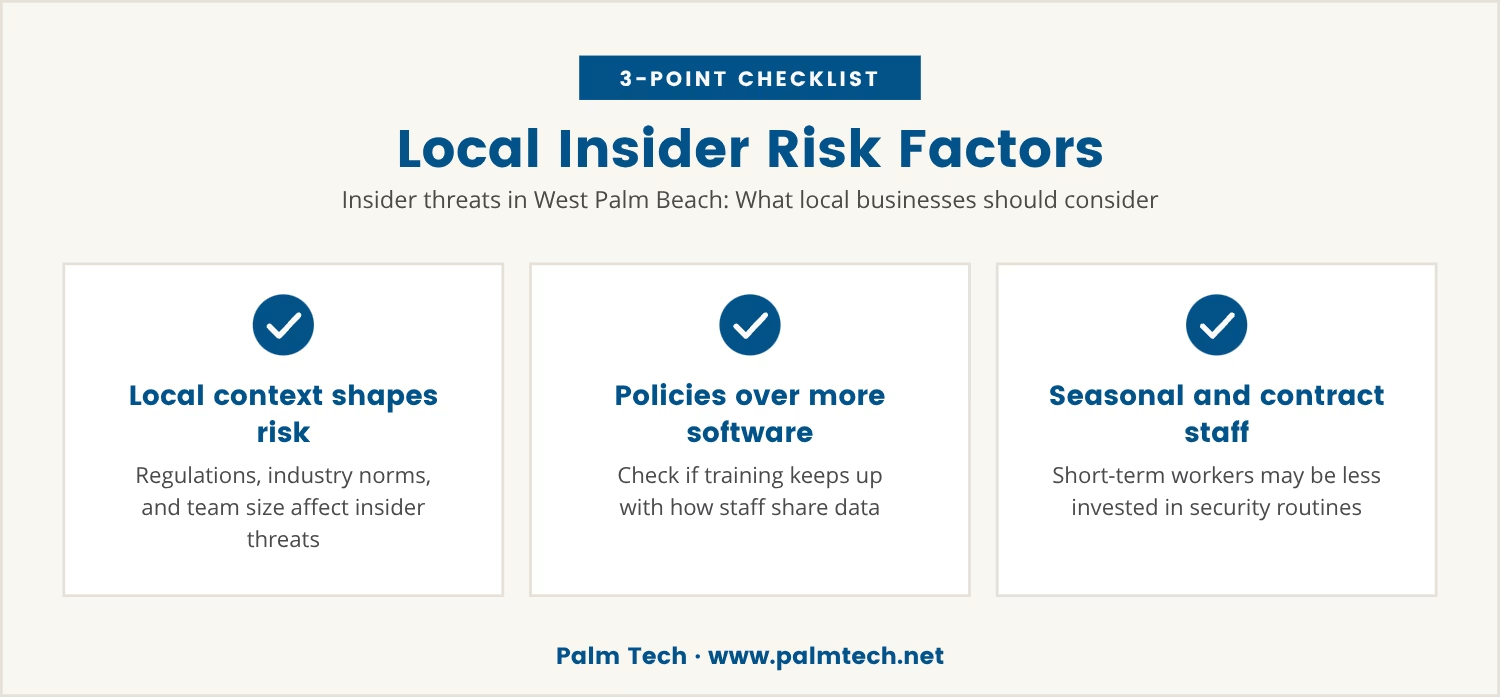
Businesses in West Palm Beach face the same low-tech blind spot as companies anywhere else, though local context still shapes how it plays out. Regulations, industry norms, and team size all influence how insider threats take shape day to day.
If your business handles sensitive data, the fix isn't more software—it's asking a harder question: Are your policies and training keeping up with the ways employees might share information, intentionally or not?
A local workforce that includes seasonal staff or contractors adds another layer of risk, since short-term employees often have less investment in following security routines. Building a culture of awareness matters just as much as having the right tools in place.
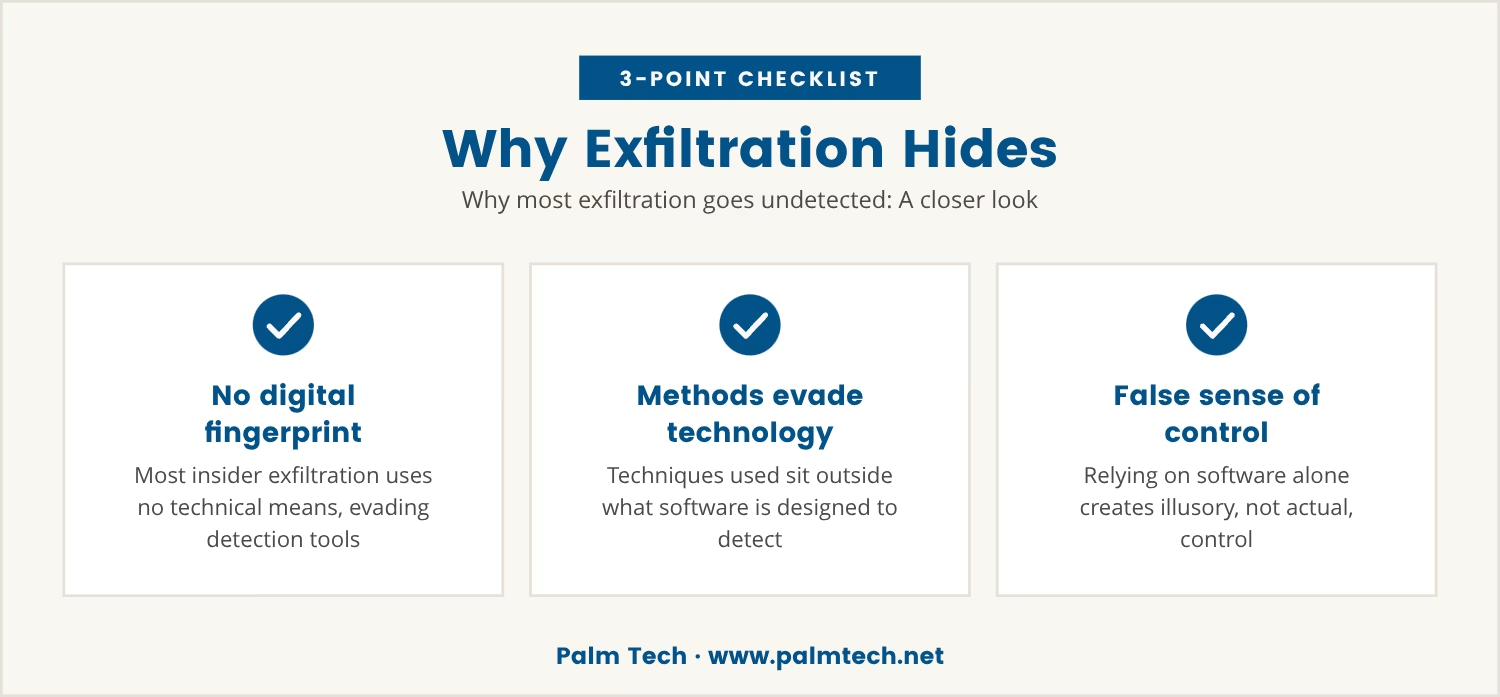
It's tempting to believe every data breach leaves a digital fingerprint, but the numbers already cited tell a different story: most insider exfiltration happens without any technical means, which makes it nearly invisible to standard detection tools.
As a result, even the best insider threat detection systems catch only a fraction of incidents. The rest slip through unnoticed, not for lack of effort, but because the methods used sit entirely outside what technology is built to see.
That distinction matters, because it shows why relying on software alone creates a false sense of control over sensitive data rather than actual control.
Closing that gap means looking past tools and toward behavior itself. These are the areas worth focusing on:
Employees need to understand the real-world consequences of sharing sensitive information, even in casual ways. Regular training keeps that awareness from fading.
Written guidelines spell out what's acceptable and what isn't, which cuts down on confusion and sets expectations for everyone.
Simple steps like restricting access to printers or locking down sensitive areas stop low-tech data leaks before they start.
Watching for unusual actions—like someone spending extra time in restricted areas—surfaces risks that software never registers.
When everyone understands they play a part in protecting information, they're more likely to notice and report suspicious behavior.
Recognizing these signs matters most if you've been pouring resources into detection tools without stepping back to ask whether they cover the full picture. Most insider threat incidents won't be caught by technology alone.
A balanced approach—pairing reliable systems with clear policies and strong training—offers a far better chance of stopping both technical and low-tech threats, and it does more to protect intellectual property and sensitive information than any single tool could on its own.
In the end, the real challenge isn't just catching cyber threats; it's understanding how everyday actions can lead to a data breach. Addressing both people and technology together is what shrinks the odds of something slipping through unnoticed.

Many businesses with 25 to 150 employees find themselves relying on more tools, only to realize they’re missing the real risks. At Palm Tech, we know how easy it is to overlook the simple ways information can leave your business.
If you want to see how we approach insider threats beyond just software, let’s talk about what would make sense for your team.
Get started with Palm Tech and pay no onboarding fees, plus you’re covered by our 90-day no-lock-in guarantee—so you can see the difference risk-free.
Look for changes in user behavior, such as employees accessing areas or information they don't usually need, or acting secretive about their work. Regular check-ins and open communication help surface unusual patterns before they escalate.
Set clear rules for handling sensitive data, limit access to physical documents, and provide regular security awareness training. Encourage employees to report anything that seems out of place, and keep policies easy to understand.
Yes, negligent insiders can cause just as much harm as those with bad intentions. Simple mistakes, like leaving documents out or sharing information without thinking, can lead to significant data loss or a breach.
Social engineering happens when someone tricks an employee into giving up sensitive information, often without the employee realizing it. Training staff to recognize these tactics lowers the odds of falling victim to insider threat attacks.
Beyond monitoring, a security team should build a culture of accountability, review physical security measures, and make sure everyone understands their role in protecting sensitive information. Pairing these efforts with technical tools creates a stronger overall defense.

Learn how to spot a phishing email effectively. This article reveals key tactics scammers.
View More
Explore why security awareness training topics need regular updates. Discover how ongoing training can enhance employee security awareness.
View More